By Peter Falussy | Last Updated: January 12, 2026
Are you planning a trip to Albania and considering car hire? After driving across the country multiple times, I can tell you this: Albania is made for road trips. While the experience comes with quirks and surprises, its freedom far outweighs the challenges.
In this ultimate guide to car hire in Albania, I’ll walk you through everything you need: why a rental car transforms your trip, how safe driving in Albania is, what documents you need, and practical tips to help you drive confidently — even on the wildest mountain switchbacks.
Quick Booking Shortcut (If You Just Want to Book)
If you already know your dates and pick-up location, you can skip straight to pricing. The quickest way to find a good deal is to compare options first — then double-check the deposit, fuel policy, and insurance excess before you pay.
- Compare deals via DiscoverCars
- Prefer a more local-style option (often simpler communication and different deposit rules depending on the provider)?
- Localrent
- Rent from Locals
Tip: If you’re travelling in July/August, book early — automatic cars and small SUVs can sell out quickly.
Why Rent a Car in Albania?
While Albania isn’t vast, its must-see destinations are scattered, and public transport won’t get you to many of them. Buses and furgons (shared vans) serve the major towns but often skip rural gems and scenic detours. Renting a car gives you total independence to discover:
- ⛰️ Albanian Alps and remote villages like Theth or Valbona
- 🏖️ Hidden beaches along the Ionian coast
- 🏛️ UNESCO sites like Berat or Butrint
- 📸 Scenic routes such as Llogara Pass and Lake Komani viewpoints
For example, on one trip I drove from Tirana to the Riviera, stopping wherever inspiration struck — a small village bakery, a roadside castle ruin, a sunset viewpoint the guidebooks forgot. With public transport, I would have missed most of it.
A rental car also saves time. Even though Albania’s distances are short, winding mountain roads and occasional roadworks can make bus travel slow. With a car, a one-week road trip in Albania can comfortably include Tirana, Berat, Butrint, and relaxing Ionian beach time.
Is It Safe to Drive in Albania?
Yes — with awareness and the right mindset. Before my first Albanian road trip, I heard stories: wild overtakes, potholes, roaming animals. I was nervous too. But the truth? It’s generally safe — if you stay alert, drive defensively, and accept that things won’t always work like in Western Europe.
While driving in Albania isn’t “relaxing” in the traditional sense, it’s completely manageable. And more importantly, it’s incredibly rewarding.
Road Conditions in Albania: Expect Variety
Driving in Albania takes you across everything from silky new highways to rugged mountain passes. Over the past decade, the government has poured investment into infrastructure, and it shows on major routes. For instance, the highway between Tirana and Shkodër is smooth and fast, while the coastal road from Vlorë to Sarandë via the Llogara Pass offers not just decent tarmac but breathtaking views. Those seeking a quieter, more sustainable ride can also consider electric vehicles — charging infrastructure is growing, and EV rentals are now a viable option across Albania.
That said, once you leave the main arteries, road quality can deteriorate fast. In rural or mountainous areas, expect:
- Narrow roads
- Deep potholes
- Long gravel stretches or crumbling tarmac
I remember following GPS from Gjirokastër to Berat — what looked like a shortcut turned into a rock-strewn path with broken edges. We had to turn around. Lesson learned: not all roads on the map are truly drivable. Offline maps (like Maps.me or organic OpenStreetMap layers) help identify sketchy routes.
Pro tip: Always ask locals or your hotel before trusting a mountain shortcut. And keep your fuel tank at least half full — petrol stations are rare in remote zones.
Top Tips for Driving in Albania: Do’s and Don’ts
If you remember nothing else, remember these. They’re the quickest way to stay safe, avoid hassle, and actually enjoy the drive.
✅ Do:
- Keep your dipped headlights on, even during the day (it’s the law).
- Drive defensively and leave space — let faster traffic pass rather than feeling pressured.
- Use your indicators whenever you can (even if others don’t).
- Give a short, polite horn on blind bends and tight mountain turns.
- Download offline maps before heading into rural areas (and don’t trust “shortcuts” blindly).
- Do a quick check at pick-up and take photos/video of every panel, wheel and the windscreen.
❌ Don’t:
- Don’t drive rural roads after dark unless you have to — visibility and unexpected hazards are the issue.
- Don’t rely only on Google Maps for mountain routes; ask locally if a road looks questionable.
- Don’t swerve for animals — slow down, brake smoothly, and wait.
- Don’t leave bags or valuables on show in the car, even for a quick stop.
- Don’t park where you block entrances or narrow roads — if in doubt, find a proper space.
- Don’t get drawn into arguments at checkpoints; stay polite and, if needed, ask for an official ticket/receipt.
Rule of the road trip: it’s not about speed — it’s about staying relaxed and getting there safely.
Tips for Driving Off the Beaten Path
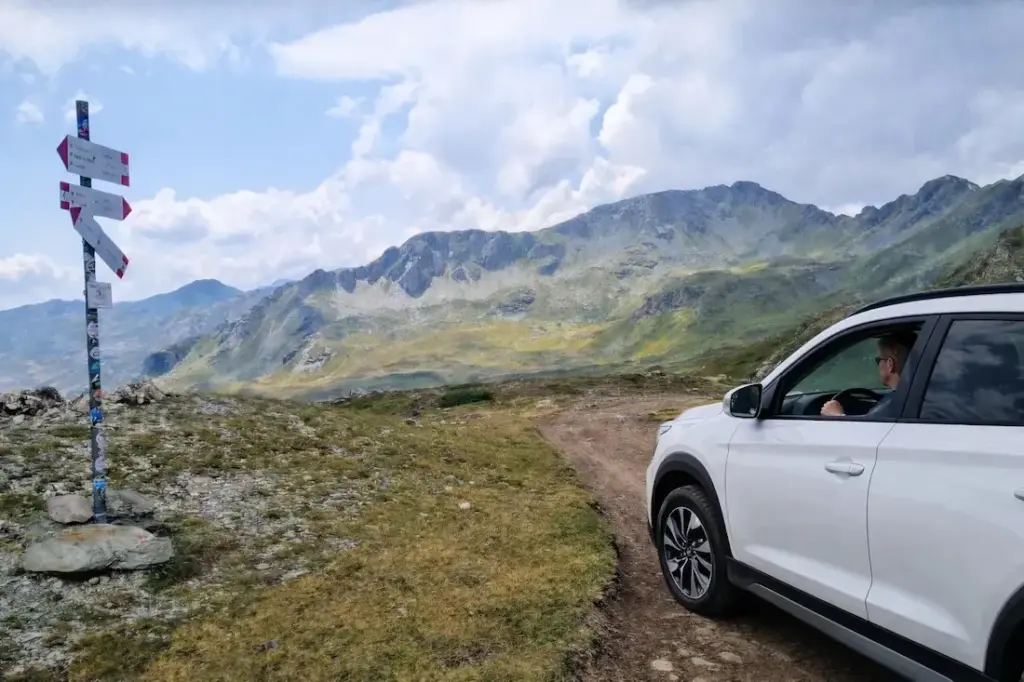
Albania’s best spots often sit at the end of rougher roads, so treat “shortcuts” with caution. If a route suddenly turns to broken tarmac or gravel, slow right down and don’t force it — ground clearance matters more than speed. After heavy rain, dirt tracks can become slippery or rutted, so ask your host locally if a road is passable that day. Keep extra fuel for remote stretches, save offline maps, and plan to reach mountain areas in daylight — it turns potential stress into an enjoyable detour.
Avoid Night Driving in Rural Areas
Country roads in Albania are pitch black at night, often with:
- No reflectors
- No streetlights
- Surprise hazards (cows, construction pits, pedestrians)
I once took a rural detour after dark, white-knuckled the entire way. Do yourself a favour: save long drives for daylight hours.
Navigation and Signage
Signage is reliable on highways: cities and towns are marked in Albanian and English. But in the countryside, you may find:
- Bullet-riddled or faded signs
- Misleading arrows
- Intersections without direction boards
Keep Google Maps or offline navigation apps handy — but know that they don’t warn about steep gradients or bad surfaces. Once, it routed me over a cobbled hill in central Tirana that even locals avoid.
Albanian Driving Habits: Jazz on Wheels
Driving culture in Albania is… freestyle. Expect:
- Infrequent use of turn signals
- Double parking (with hazard lights = universal excuse)
- Horns as communication, not aggression
- Lanes as suggestions
While it may seem chaotic, it’s rhythmic once you adjust. I treated it like improvisational jazz — anticipate, adapt, and go with the flow. With a calm head and defensive driving, even Tirana traffic becomes manageable.
Watch Out for Animals on the Road
One of the most distinct aspects of driving in Albania is sharing the road with… livestock. Yes, really. Outside major cities, encountering animals is almost guaranteed. Think:
- 🐐 Goats wandering mountain lanes
- 🐄 Cows camped at junctions
- 🦃 Turkeys strutting across highways
- 🐴 Donkeys blocking village roads
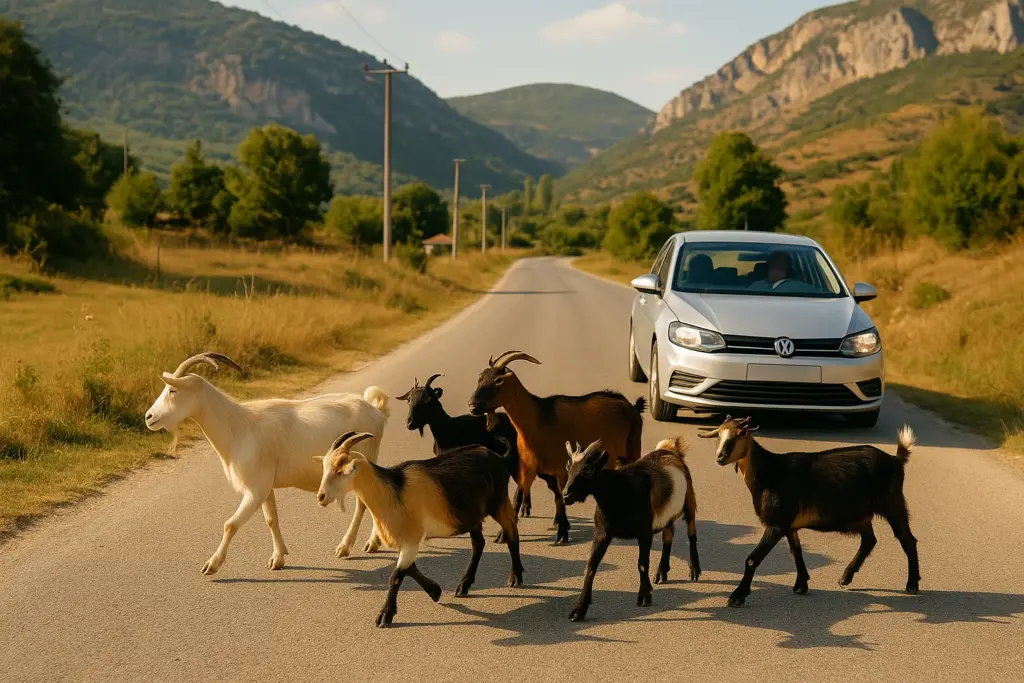
And it’s not a rare “once-a-trip” thing — I’ve braked for entire herds led by staff-wielding shepherds, and waited as sheep nonchalantly circled roundabouts.
Even if you’re a Giro d’Italia rider, you’re not safe from goats, it happened in May 2025:
While these moments are charming (and excellent for your Instagram), they also demand caution. Here’s how to handle them:
✅ Tips for Driving Around Animals
- Slow down near bends or hills, especially in the countryside.
- Look for clues: shepherds, dusty footprints, barking dogs.
- Use your horn gently if needed — never aggressively.
- Don’t swerve. Brake and wait. Jerking the wheel could cause real danger.
- Be extra alert at dawn and dusk — prime herding times.
These surprise animal encounters become stories you’ll retell for years. Like the time a donkey just stood in the middle of SH8, refusing to move as drivers calmly detoured around it like a local landmark.
Police Checks & Speed Traps: What to Expect
You’ll likely come across police checkpoints during your Albanian road trip, especially in summer. Don’t stress: most are routine, especially if you’re driving a rental car as a tourist.
📝 What to Have Ready
- Valid driver’s licence (an IDP is often not mandatory for Latin-script licences, but it can reduce hassle — especially with smaller local suppliers or at checkpoints)
- Hire car documents (registration, proof of insurance)
- Green Card insurance if you’re planning cross-border travel
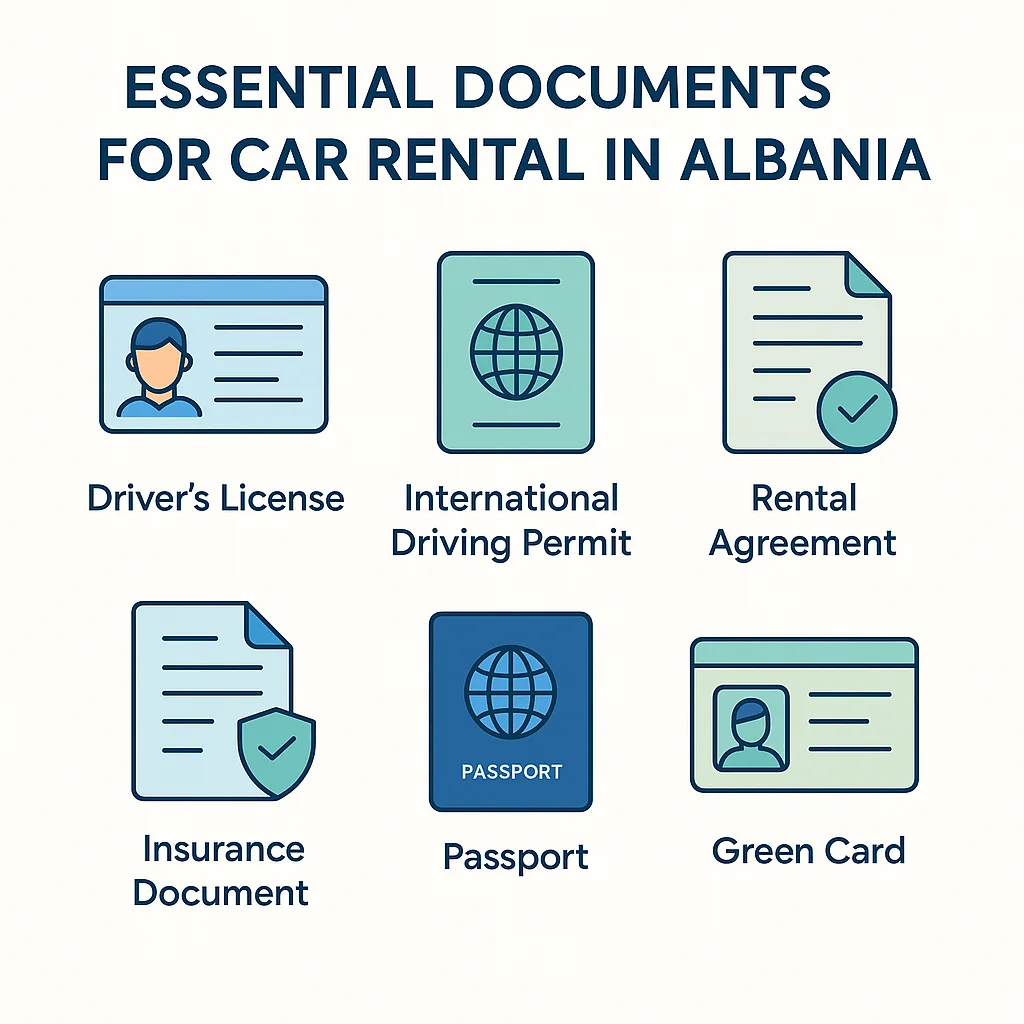
Officers might ask where you’re headed, flip through your documents, and wave you on with a friendly “Mirëdita!” Just stay polite and cooperative.
🚨 Speed Traps in Albania
Police use radar to monitor speeds near town entrances/exits, where limits can drop abruptly. Locals often flash headlights to warn each other (watch for that!).
⚠️ A few things to know:
- Fines may be issued on the spot.
- If anything feels unclear, stay calm and politely ask for an official ticket/receipt before paying anything.
Stay calm, courteous, and avoid escalation. This is the Balkans — charm gets you farther than confrontation.
✅ Key Driving Laws to Remember
- ✅ Headlights ON during the day (yes, it’s the law)
- ✅ Seat belts are required for all passengers
- ✅ Hands-free only for mobile phone use
- ❌ Alcohol? Don’t risk it. The legal BAC is extremely low — treat it as zero and don’t drink if you’re driving.
By keeping these basics in mind, police encounters won’t feel intimidating. I once had an officer suggest a local restaurant during a stop. That’s Albania.
Renting a Car in Albania – What You Need to Know
Renting a car in Albania is usually straightforward — but the details matter. If you get the car type right, understand the deposit/insurance excess, and confirm the fuel policy and cross-border rules upfront, you’ll avoid nearly all the common headaches.
🚗 Choosing the Right Car
- Manual cars dominate. Need automatic? Book early.
- Expect cosmetic wear — it’s normal on Albanian roads.
- Best choices:
- Economy: cities and coast
- Compact SUV / 4×4: mountains like Theth, Valbona
- Economy: cities and coast
- Inspect and photograph the car, even small scratches
I’ve had cars with over 100,000 km — still totally reliable. Just ask for the newest model available if that’s a concern.
Deposits, Credit Cards & Debit Cards
In Albania, the “gotcha” is rarely the daily rate — it’s the deposit hold and how insurance excess is handled.
Most mainstream rentals will require a credit card in the main driver’s name and place a pre-authorisation hold that can roughly match (or exceed) the insurance excess. That money isn’t charged, but it can take time to release after you return the car.
If you’re travelling without a credit card (or you simply want to avoid a large hold), some local providers can be more flexible — but terms vary by car, season, and pick-up location. This flexibility often extends to age requirements too, so if you are under 25, I highly recommend checking my specific guide on car rental in Albania under 25 to find the local fleets that actually welcome younger drivers without massive daily surcharges.”
Either way, confirm these three points before you pay:
- the deposit amount (and whether it’s a hold or a charge)
- the insurance excess (your maximum liability)
- which payment cards are accepted (and in whose name)
Everything for a Safe Road Trip – Car Hire in Albania
- Mondat: If you want to skip the high airport deposits entirely, read the full process for car rental in Albania with a debit card through local fleets.
💶 Rental Costs & Insurance Options
As a rough guide, prices tend to be lower outside peak season and can climb sharply in July/August — especially for automatics and small SUVs. Check what’s included:
- CDW (Collision Damage Waiver) is usually standard — but has a high excess (€800–1,000)
- Full coverage or Super CDW drops your liability to near-zero — worth it for peace of mind
Two-minute insurance clarity: In Albania, the most expensive “small” damage often involves things like tyres, glass, and underbody scrapes — and these are commonly excluded from basic cover. CDW is often included, but it usually comes with a high excess (your maximum out-of-pocket amount if something goes wrong).
If you want true peace of mind, don’t just look for the words “full coverage” — check exactly what’s excluded and what the process looks like if you need to claim.
💡 Travel tip: Your credit card or travel insurance might include car rental coverage — bring proof. For a comprehensive understanding of car rental insurance options in Albania, including CDW and full coverage, check out our detailed guide.
Where to Book
Tirana Airport has the widest choice, but city pick-ups can sometimes be better value. If you’re arriving via Corfu, Sarandë is a common starting point for the south. Vlora Airport car hire is expected to become an option in 2026 — see the latest here: Vlora Airport Car Rental 2026 Opening, Travel Time & Alternatives
- Before you confirm, do a quick 60-second check:
- Fuel policy (full-to-full is the easiest to manage)
- Deposit + excess (know your real worst-case cost)
- What’s included/excluded (tyres, glass, underbody are the usual surprises)
- Roadside assistance number and what it covers
- Cross-border permission (only if you need it — get it in writing)
- At pick-up: spare wheel/jack, warning triangle, and take photos of every panel
With the right prep, your Albanian road trip will be smooth, scenic, and wonderfully spontaneous — the best way to explore the country on your terms.
Trusted Rental Car Platforms for Albania
When you’re ready to book your car hire in Albania, choosing a reliable provider makes all the difference. Based on experience and community reviews, here are three trusted platforms that deliver value and support:
- 🔹 DiscoverCars (comparison-first)
Globally trusted, with a 4.6 rating on Trustpilot, based on 246k reviews (as of 13 December 2025). User-friendly and secure, with powerful comparison tools. Great for first-timers and with wide availability across Albania. - 🔹Localrent (local providers, more flexibility depending on listing)
A Balkan specialist connecting you with local providers. Best for cross-border rentals and more flexible insurance options. Ideal for road trips into Montenegro or North Macedonia. - 🔹 Rent from Locals (more personal communication)
Prioritise local knowledge and personal service? This is your go-to. Drivers report quick communication, real-time issue resolution, and even route tips from Albanian hosts.
🚗 Ready to hit the road? Compare these platforms, find your match, and lock in your ride — especially during summer, early booking is a must.
3 Inspiring Albania Road Trip Itineraries
Whether you have 3 days or a full week, here are three curated Albania road trip plans for different travel styles:
🗓️ 3-Day Express Circuit: A Quick Albanian Sampler
Ideal for a short visit — a mix of culture, coast, and countryside.
- Day 1: Tirana ➝ Berat
Visit Tirana’s landmarks, then explore Berat’s Mangalem Quarter and hilltop castle. - Day 2: Berat ➝Vlorë
Scenic inland drive. Stop at the Apollonia ruins. Enjoy Vlorë’s Adriatic beach. - Day 3: Return via Ardenica Monastery or an inland shortcut.
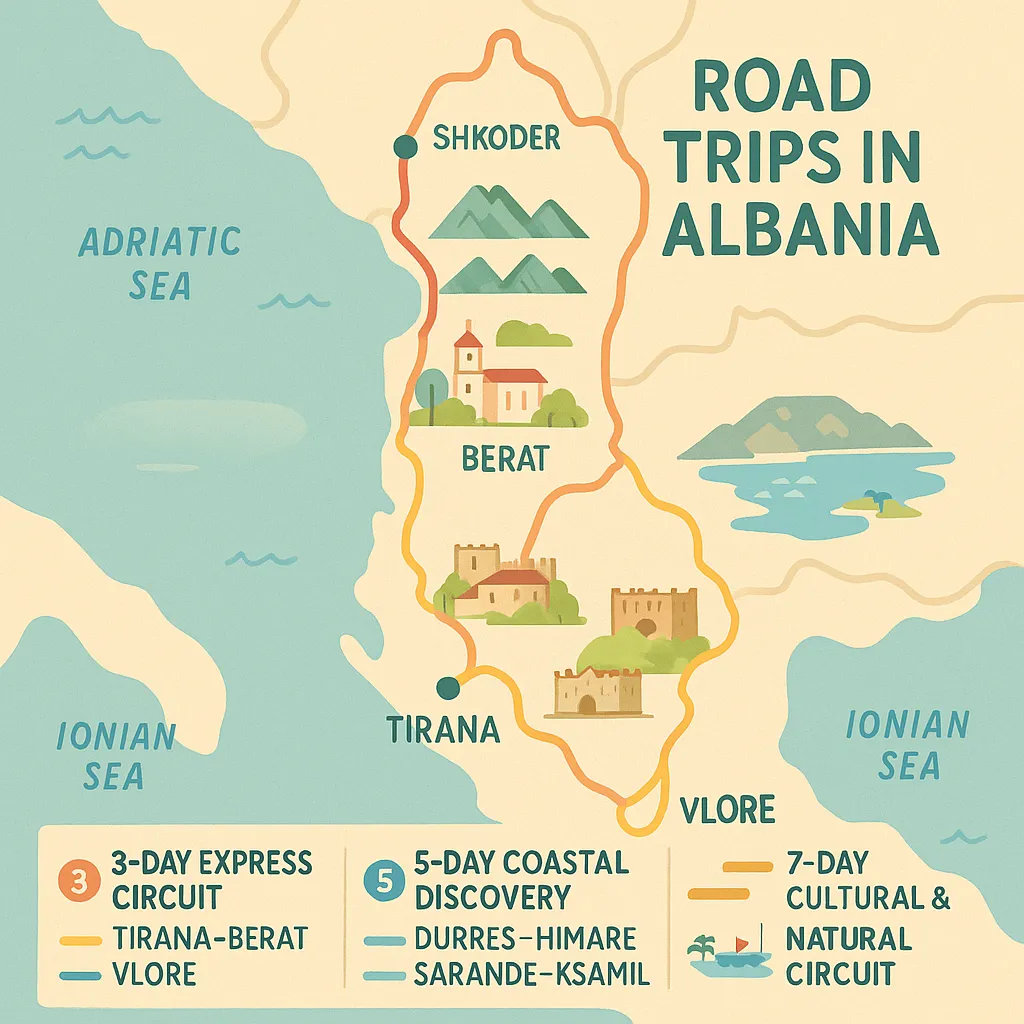
🏖️ 5-Day Coastal Discovery: Riviera & Ruins
Perfect for beach lovers and history buffs.
- Day 1: Tirana ➝ Durrës
Roman amphitheater + seaside stroll. - Day 2: Durrës ➝ Himarë (via SH8 + Llogara Pass)
Epic views + optional stop at Zvërnec Island. - Day 3: Himarë ➝ Sarandë
Beach-hop: Jale, Livadhi, Borsh. - Day 4: Butrint + Ksamil
UNESCO site + tropical-style beaches. - Day 5: Return to Tirana via inland or coast.
🏞️ 7-Day Cultural + Natural Circuit
Great for those who want mountains + heritage.
- Day 1–2: Tirana + Shkodër
Rozafa Castle, Marubi Museum, and city vibes. - Day 3: Komani Lake Ferry ➝ Valbonë
Albania’s answer to a fjord cruise. - Day 4: Valbonë ➝ Theth (via trail or 4×4 road)
Epic alpine scenery either way. - Day 5–6: Theth ➝ Berat
Down to wine country and Ottoman charm. - Day 7: Return to Tirana — optional detour to Elbasan or Lake Ohrid.
🗺️ Travel Tip
Albania rewards the spontaneous. Don’t overpack your itinerary — leave space for detours, roadside cafés, and viewpoints the maps don’t show.
With the right car rental partner and a flexible plan, your Albanian road trip will be unforgettable.
Parking in Albania: What You Need to Know
Parking in Albania is a mix of clear rules and local improvisation. In cities you’ll often see painted bay lines, while in coastal towns you’ll also run into informal attendants guiding cars into “whatever works”.
City parking (Tirana, Durrës, Sarandë)
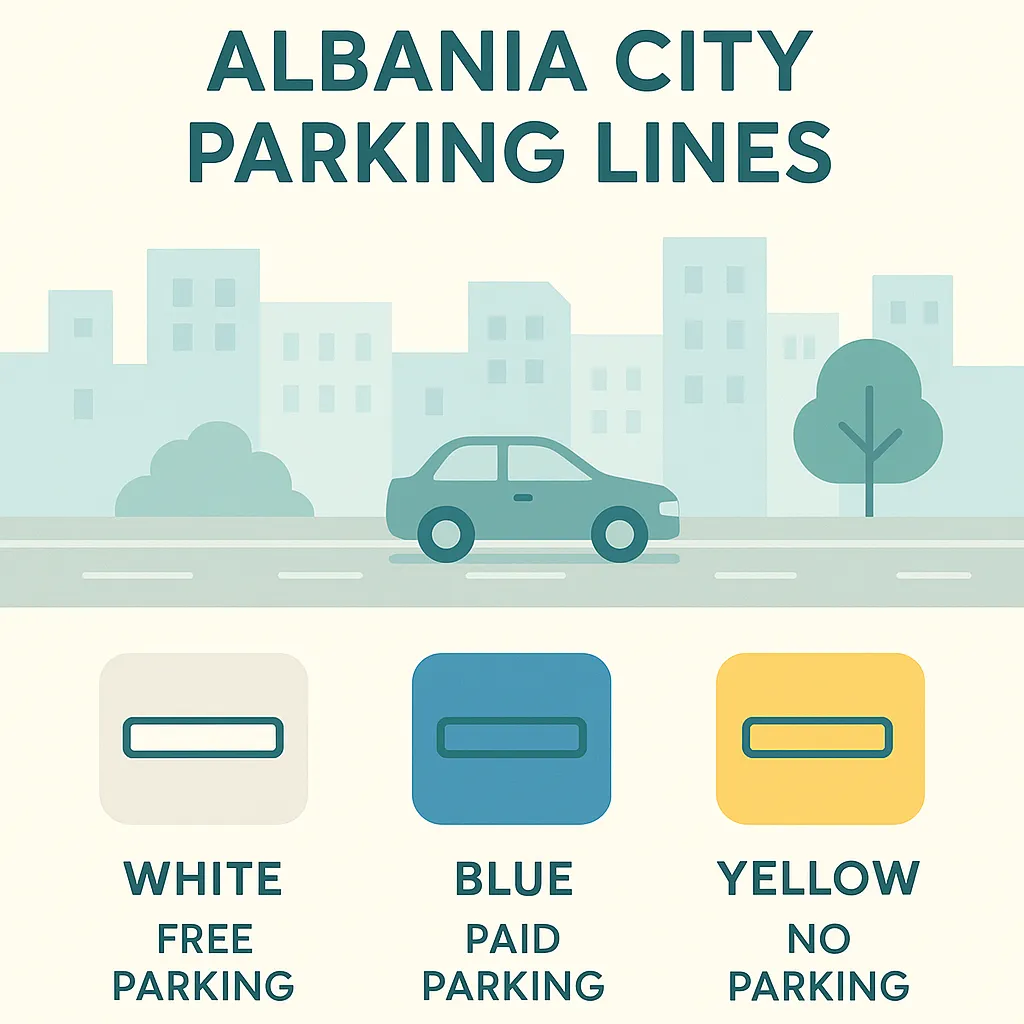
In marked street bays, the line colours usually give you a clue:
- White lines often indicate free parking
- Blue lines are typically paid parking (look for a nearby metre, kiosk, or local instructions)
- Yellow lines usually mean no parking (higher risk of a fine or towing)
In central Tirana (especially around Blloku), spaces can be scarce — it’s easier if you arrive earlier in the day or choose accommodation with parking.
Coastal towns (Himarë, Sarandë, Ksamil)
In July and August, parking becomes part of the daily routine:
- Car parks and beachfront spaces can fill up by late morning
- You may be directed by informal attendants to unofficial spots — if you use one, agree any fee upfront and keep it modest
- Avoid blocking narrow roads, gates, and driveways — if a road feels “too tight”, assume it needs to stay clear
Rural areas and mountain villages
Parking is generally more relaxed, but common sense matters:
- Park where locals park, but don’t block passing places or farm entrances
- In historic hill towns (e.g. Berat, Gjirokastër), it’s often easiest to use a designated visitor car park and walk in
Quick parking habits that save hassle
Carry some cash in lek for small fees, especially outside big centres. Don’t leave valuables on show (even for a quick stop), and take a photo of where you’ve parked if the streets look similar.
Bottom line: follow the markings where they exist, stay flexible where they don’t, and when in doubt, ask your host or a nearby shopkeeper — it usually takes 10 seconds and saves 30 minutes.
Seasonal Driving in Albania: Month-by-Month Tips
Albania’s driving conditions change quickly with altitude and location. The coast can feel like a different country from the mountains, so it’s worth planning with the season in mind — especially if you’re heading north.
Winter (December–February)
Above roughly 800m, snow and ice are common, and some mountain roads can become difficult or temporarily impassable.
Snow chains may be required, and some rental companies restrict access to high areas unless you book a 4×4. If you want the easiest winter driving, stick to the coast and lower elevations.
Spring (March–May)
Spring is one of the nicest times to drive: greener landscapes, lighter traffic, and generally good visibility.
That said, unpaved tracks can stay muddy after rain, and “shortcuts” in rural areas can be misleading. If you’re heading off the main roads, allow extra time and don’t force a route that looks questionable.
Summer (June–August)
Peak season means more traffic, tighter parking in beach towns, and slower progress on popular routes.
In hot weather, long queues and stop-start city driving can make cars run warm, so plan longer drives earlier in the day and keep water in the car. Expect more police checks in tourist areas and around town entrances.
Autumn (September–November)
Early autumn is a sweet spot: warm days, fewer crowds, and smoother road trips.
From late October onwards, rain becomes more likely, daylight gets shorter, and rural roads can feel more slippery — so start drives earlier and avoid pushing on after dark.
Quick road trip habits that help in any season
Keep the fuel tank comfortably above empty before remote stretches, carry water and a torch, and save offline maps. If locals tell you a road is “not good today”, believe them — it’s usually the best advice you’ll get all week.
When to visit
For most travellers, late spring and early autumn offer the best balance of weather, road conditions, and lower crowds — while mid-summer is great for the coast but demands earlier starts and more patience.
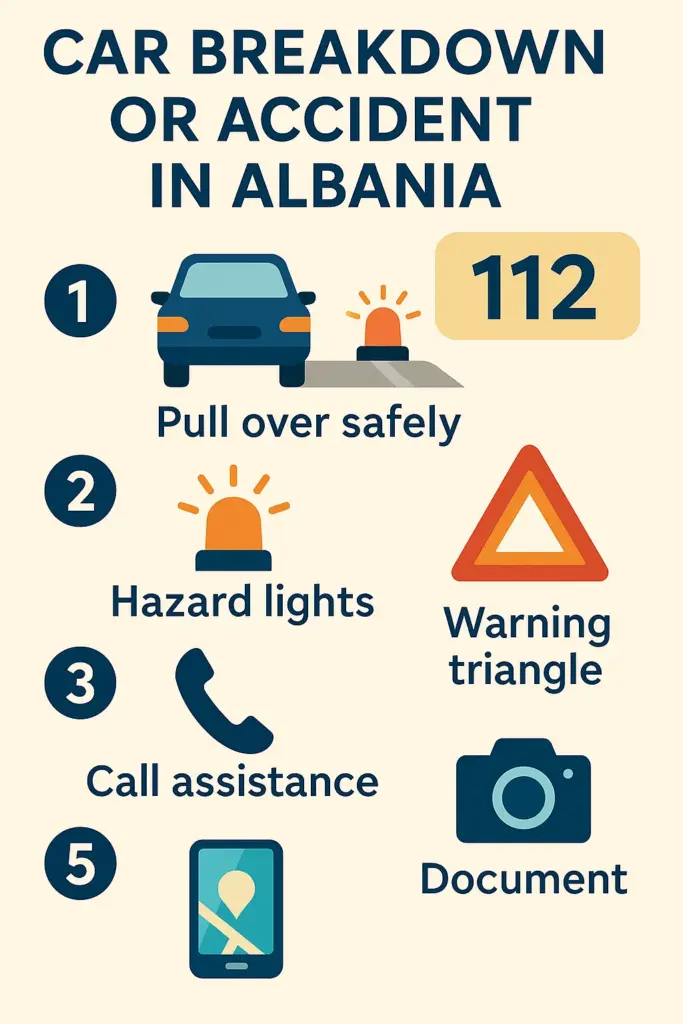
How to Handle a Car Breakdown or Accident in Albania
Even with good preparation, things can happen: a puncture, a flat battery, overheating in summer traffic, or a minor bump in a tight car park. The key is to stay calm, make the scene safe, and follow the steps your rental provider expects.
If the car breaks down
1) Pull over safely — get well off the road if you can.
2) Hazard lights on immediately.
3) Use the warning triangle (place it well behind the car; it’s legally required).
4) Call your rental company’s roadside assistance number (save it before you start driving).
5) Stay with the vehicle unless it’s unsafe — on faster roads, stand behind a barrier if there is one.
Most issues are solved quicker than you’d think — either a local mechanic turns up, or the provider sends a replacement car.
If you’re in an accident
1) Check for injuries first. If anyone is hurt, call emergency services.
2) Call 112 for emergency help (police/ambulance/fire). If you can, share a location pin.
3) Make the scene safe — hazards on, triangle out, move passengers away from traffic.
4) Document everything: photos of both vehicles, number plates, the road, and any damage.
5) Contact your rental provider before you agree to anything you don’t understand.
Important: even small accidents may require a police report for insurance to be valid, so follow your rental company’s instructions.
Emergency numbers in Albania
- 112 – general emergency (can connect you to police/ambulance/fire)
- 129 – police
- 127 – ambulance
- 128 – fire
Note: not every operator will speak fluent English. Speak slowly, use simple words, and share your location clearly.
Insurance & damage tips that prevent expensive surprises
- Know your excess (your maximum out-of-pocket amount).
- Clarify whether tyres, glass, and underbody are covered.
- Don’t sign paperwork you don’t understand — call your provider first.
A simple “just in case” kit
Keep water, a phone charger, a torch, and basic first aid in the car — especially if you’re driving into rural areas.
With a bit of preparation, most problems become short delays rather than disasters. Thousands of travellers drive Albania safely every year — you can too.
Driving Beyond Albania: Cross-Border Rental Tips
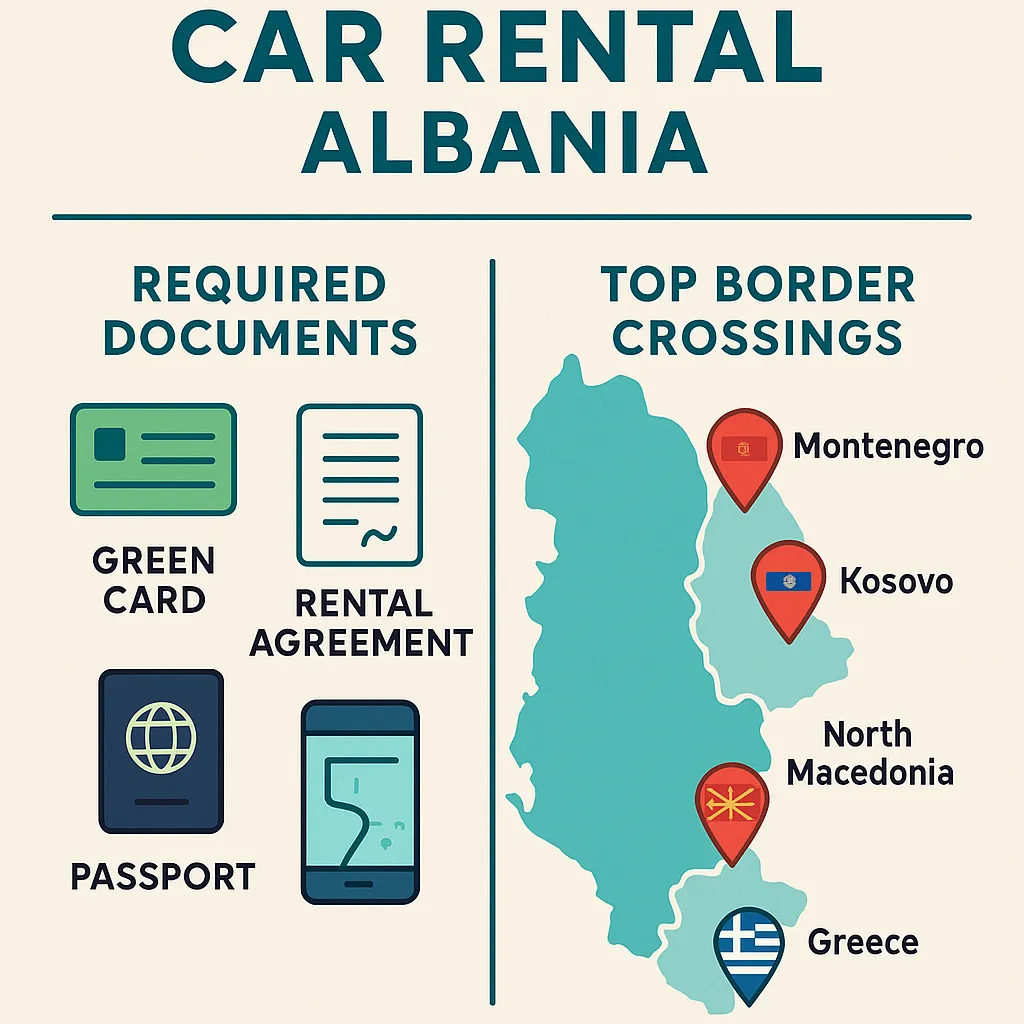
Thinking about taking your rental car into Montenegro, Greece, Kosovo, or North Macedonia? It can be a brilliant add-on — but only if the paperwork is sorted before you reach the border.
What you must confirm before you go
1) Written permission from the rental company
Not every provider allows cross-border travel. If they do, you’ll usually need it stated in writing (in your rental agreement or as a separate authorisation).
2) Insurance proof / Green Card (and the country list)
Cross-border cover is not automatic. Ask your provider exactly what document you need as proof of insurance for your destination(s), and make sure the countries you plan to visit are listed/covered. If something isn’t included, you may need to arrange additional cover.
3) Your travel documents
Carry the passport/ID documents required for your nationality for each country you’re entering, plus your driving licence and the rental paperwork.
Practical border-crossing tips (that save time)
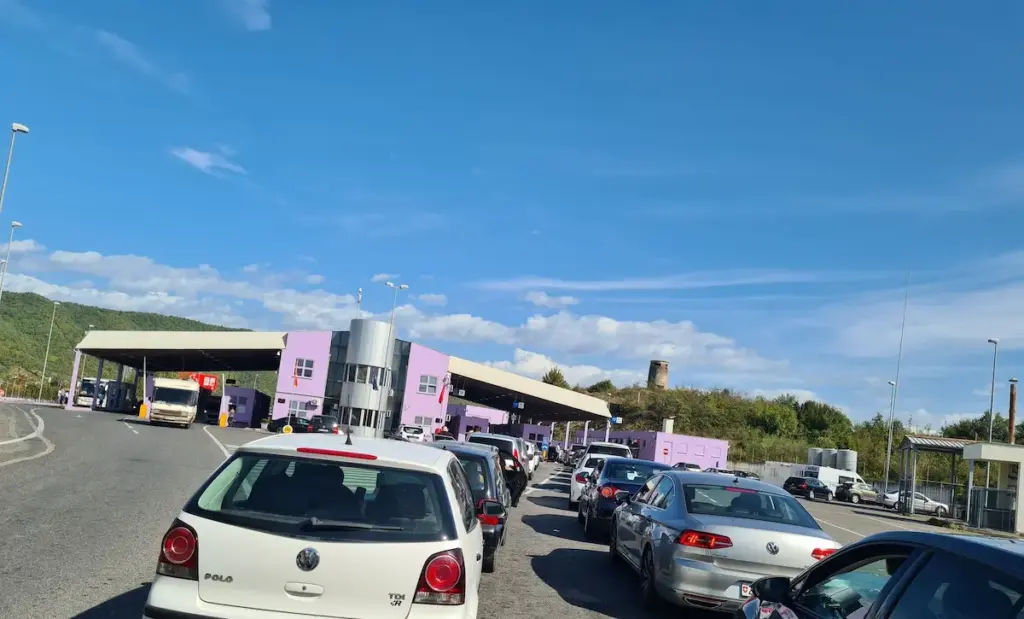
- Expect longer queues in peak summer, especially on weekends.
- Keep your documents together and easy to hand over.
- Don’t rely on mobile data at the border: download offline maps and keep a location pin saved.
- Have a little cash handy for small fees and stops along the way.
Common crossings travellers use
Routes vary by itinerary, but popular corridors include the Montenegro border via the Shkodër area, North Macedonia near Lake Ohrid, and Greece via the south. Your best move is to choose the crossing that matches your route and time of day, then build in buffer time in summer.
Bottom line: cross-border driving is very doable — just don’t improvise the paperwork. Confirm permission + insurance coverage in writing before you leave Albania, and your road trip stays fun rather than stressful.
Border rules in the Balkans are complex and change yearly. For a deep dive into fees, Green Card requirements, and which borders to avoid, read my complete Albania cross-border car rental guide.
Top Tip: Localrent offers great cross-border flexibility and understands Balkan logistics for regional travel.
Embrace the Road, Embrace Albania
Driving in Albania can feel unfamiliar at first — potholes, local traffic habits, and the occasional animal crossing — but with a bit of preparation and a calm mindset, it becomes one of the most rewarding ways to explore the country.
A car gives you freedom: to stop for viewpoints, take scenic mountain passes, and reach places public transport simply doesn’t. Drive defensively, plan longer legs in daylight, and stay flexible — Albania is at its best when you leave room for the unexpected.
So fill up, put on your favourite playlist, and enjoy the road.
FAQs: Car Hire & Driving in Albania
1., Is it safe to drive in Albania?
Yes, as long as you drive defensively and stay alert. Driving standards and road surfaces can vary, especially outside main routes, but most travellers manage it without issues once they adjust to the local flow.
2., Do I need an International Driving Permit (IDP)?
If your driving licence is in the Latin alphabet (UK/EU/US), an IDP is often not mandatory, but it can reduce hassle — particularly with smaller local suppliers or at checkpoints. Rules and enforcement can vary, so it’s a low-cost backup if you want peace of mind.
3., Can I hire a car with a debit card?
Sometimes, but it depends on the supplier and the car category. Many providers prefer a credit card for the deposit pre-authorisation. If you’ll be using a debit card, confirm acceptance in writing before you pay.
4., How do deposits and the insurance excess work?
Most hires involve a deposit hold (pre-authorisation) and an insurance excess (the maximum you may pay if there’s damage). The daily price can look great, but the deposit/excess is what matters most — always check both before confirming your booking.
5., Are automatic cars available to hire?
Yes, but they’re less common and usually cost more. In peak season, automatics and small SUVs can sell out quickly, so it’s worth booking early if you need one.
6., What insurance should I choose?
Basic cover often includes CDW, but with a high excess and common exclusions (tyres, glass, underbody). If you want fewer surprises, focus on what’s excluded and what the claims process looks like — not just the label “full cover”.
7., Can I drive my hire car to neighbouring countries?
Often yes, but only with the rental company’s written permission and the correct insurance proof for your destination(s). Don’t assume it’s included — confirm the country list and paperwork before you reach the border.
8., Are fuel stations easy to find?
On main routes and around towns, yes. In remote areas (especially mountains), stations can be sparse — fill up before long rural stretches. “Petrol” and “diesel” are the standard options.
9., What should I do if the car breaks down or I have an accident?
Call your rental company’s roadside assistance first, make the scene safe (hazards + warning triangle), and document everything with photos. For emergencies, call 112. Even minor accidents may require a police report for insurance.
10., Do rental staff and police speak English?
In cities and tourist areas, often yes. In rural areas it’s less predictable — speak slowly, use a translation app if needed, and keep key real-world details ready (location pin, booking reference, number plate).
About the Author
As a property owner on the Albanian coast, I not only rent out holiday apartments but also travel and document the country extensively. My articles share first-hand tips about accommodation, beaches, hikes, and prices in Albania, including practical advice. This article may contain affiliate links — at no extra cost to you — which help keep this site running. I only recommend services I’ve tested or verified personally. Thanks for reading and supporting independent travel content!
Most photos in this article are my own, taken during travels across Albania. Other sources are credited where used.
🇦🇱 Enjoy the journey, follow the rhythm of the road, and let Albania surprise you at every turn.
Happy travels — gjithë të mirat!